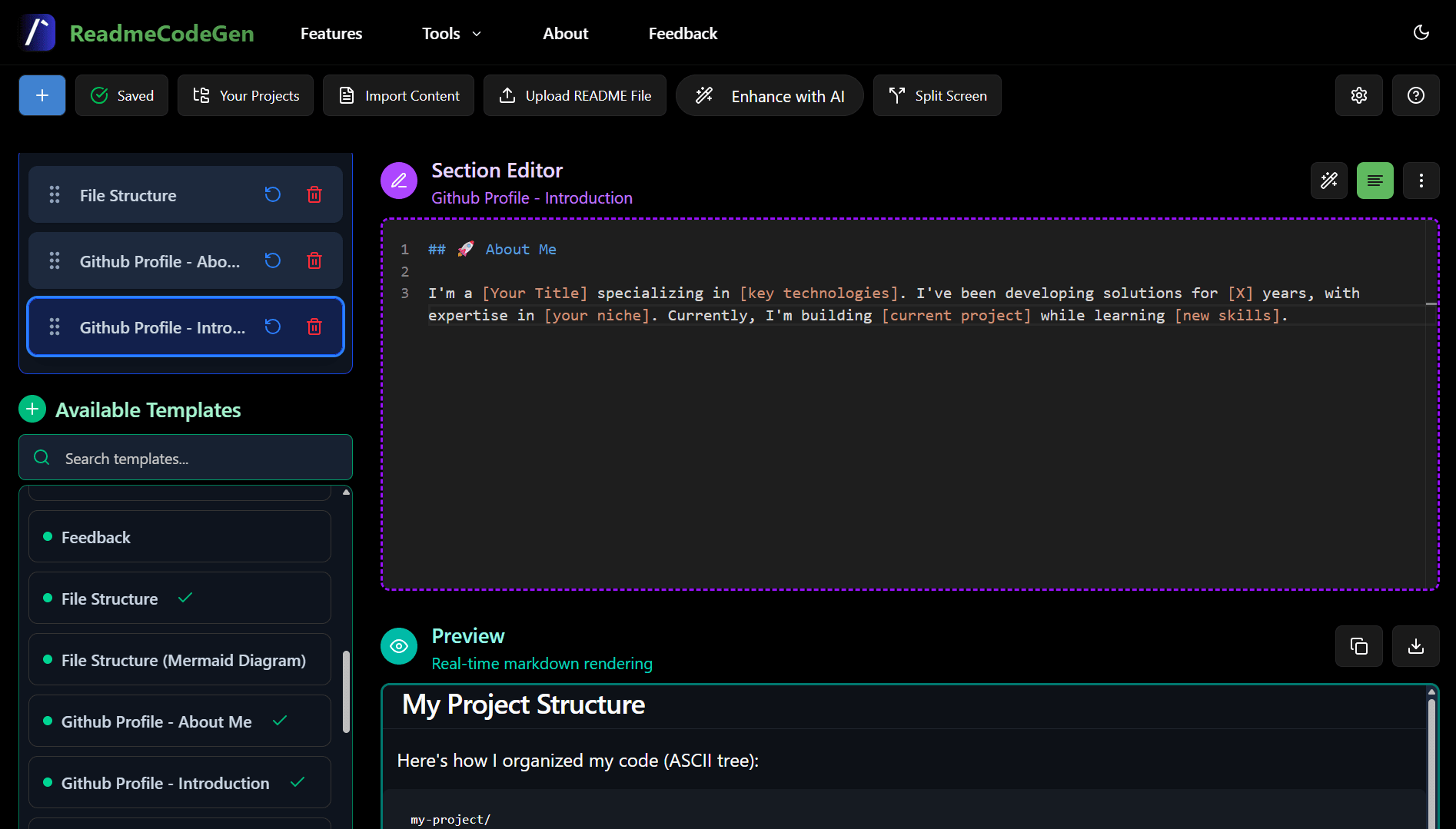
Everything in one screen — no tab-switching
Templates on the left, markdown editor in the middle, live GitHub preview on the right. Your README takes shape as you type.
40+ sections total
PDFWrite
Description
A Next.js app for converting PDFs into editable Markdown using AI extraction.
Features
AI text extraction
Rich markdown editing
Cloud sync via Supabase
Table of Contents
Features
Installation
Contributing
Left: pick & drag sections — Middle: write with toolbar tools — Right: live GitHub-rendered preview
One click to insert — no markdown syntax to memorise
Badges, link buttons, file trees, social icons — everything that normally requires looking up syntax is a single button inside the editor toolbar.
Insert Badge
shields.io badges for license, build status, version
Insert Link Button
Styled CTA buttons — demo, docs, deploy links
Insert File Tree
Visual project folder structure in plain markdown
Insert Social Icons
Twitter, LinkedIn, GitHub profile link buttons
Auto Generate
AI writes the full section from your repo URL
AI that works inside your editor, not instead of it
Highlight a paragraph to get inline improvements, or paste a GitHub URL for a full auto-generated first draft. The AI reads your actual code — not generic templates.
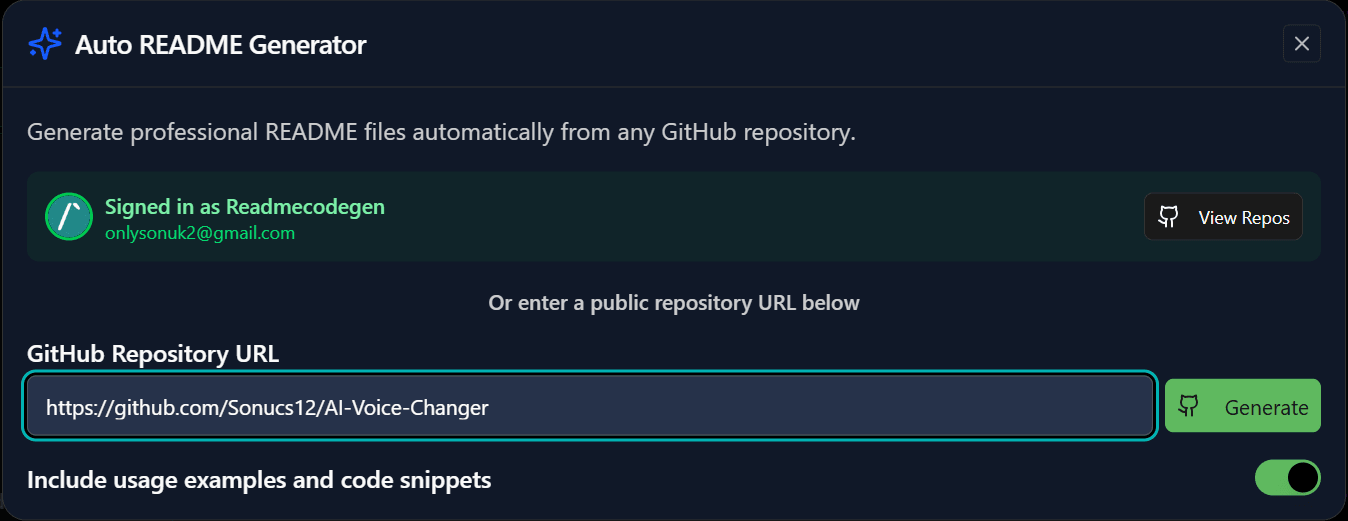
Auto-generate from URL
Paste any public GitHub repo. AI reads your code, detects your tech stack, and writes the README — no manual input.
Enhance with AI
Select any paragraph and click Enhance. AI rewrites for clarity, fixes grammar, and improves tone. Compare before accepting.
Import existing README
Upload your current README.md and improve it section by section. No need to start over from scratch.
Private repo support
Connect via GitHub OAuth to access private repositories. AI analyzes private code without storing it.
Start to shipped README in five steps
No account needed. Opens instantly.
Open builder
No signup needed
Paste repo URL
or pick templates
Drag sections
arrange your story
Edit + preview
live GitHub render
Download .md
push to your repo
Everything a good README generator needs
Most tools give you a blank form. This one reads your code and writes from it.
40+ ready-to-use templates
Every common README section — Features, Installation, API docs, Contributing — pre-built and following GitHub markdown conventions. Pick what fits your project and skip the blank-page problem entirely.
Drag-and-drop section builder
Rearrange your README sections by dragging them into order. Add, remove, or duplicate any block without touching markdown. Works the way your brain does, not the way editors force you to.
Live markdown preview
Split-screen editor shows your rendered output as you type. Badges, tables, code blocks, and images all render exactly as they'll appear on GitHub — no surprises when you push.
From repo URL to README.md in four steps
The automatic README generator handles the research so you only deal with the editing. Paste a URL, review the draft, adjust what you want, download.
Step 1
Paste your repository URL
Drop any public GitHub repo URL into the input field. The AI README generator fetches your repository, reads every file, maps your folder structure, and identifies dependencies — all in a few seconds. No manual input needed to get a first draft.
Step 2
Connect GitHub to access private repos
Authenticate with GitHub OAuth to pull in private repositories alongside public ones. Your token stays local — the tool reads repo data to generate the README and nothing else. Useful for teams who need documentation on internal projects without copy-pasting code.
Step 3
AI reads your actual codebase
Rather than generating generic placeholder text, the AI reads your actual files — package.json, imports, folder structure, test setup, CI config. It identifies React versus Vue, spots TypeScript configs, detects your testing framework, and writes README content that accurately describes what the project does.
Step 4
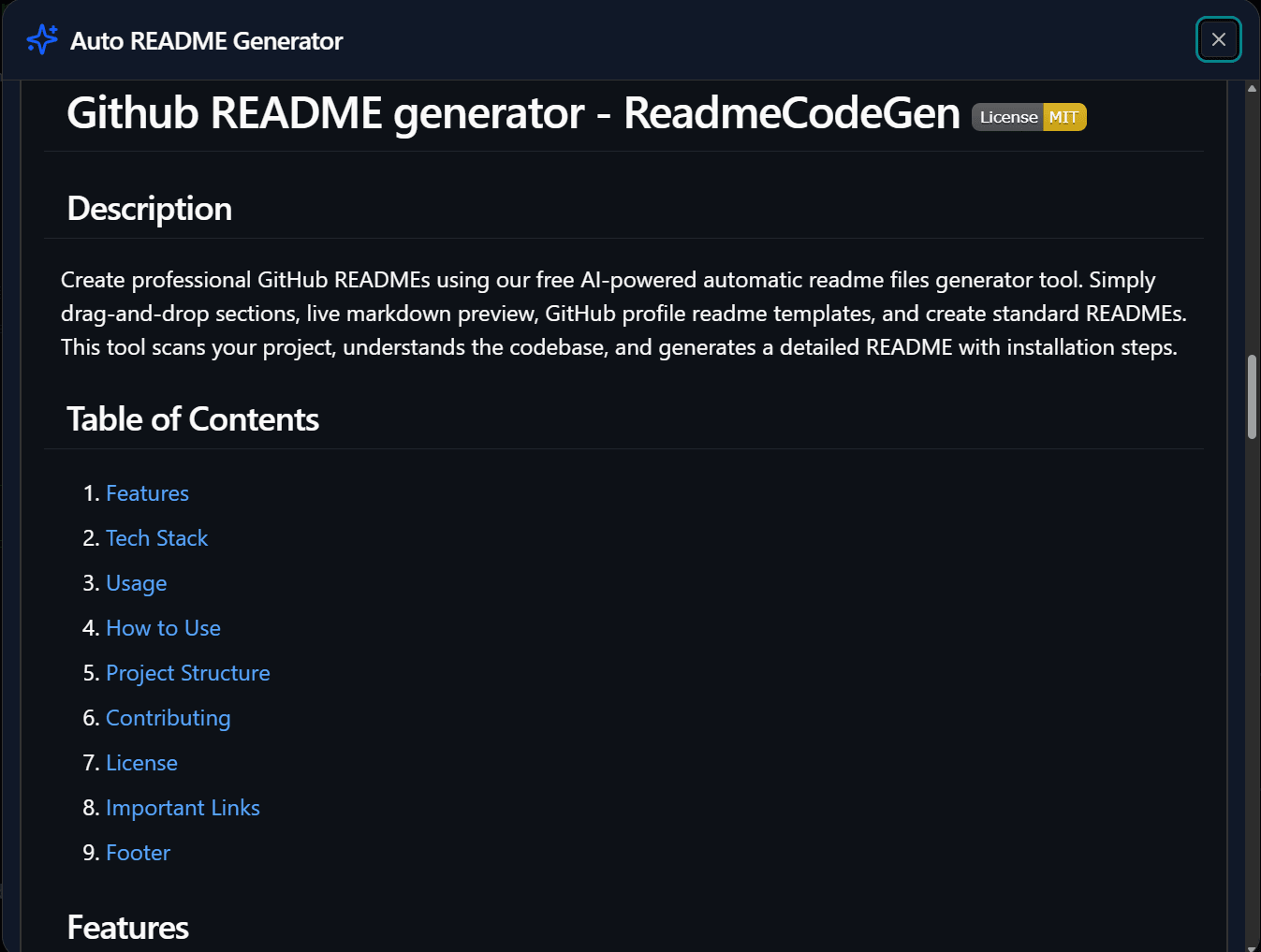
A complete README, ready to ship
The output is a production-ready README.md with project description, features list, installation steps, usage examples, and contributing guide — all accurate to your repo. Use it as-is, or open it in the editor to adjust tone, add screenshots, or rearrange sections.
How to create a README file for GitHub
Whether you're documenting an open-source project, a portfolio piece, or a private team repo, the process takes under ten minutes. No markdown experience required.
Open the builder — no signup needed
Hit the button below and you're in immediately. No account creation, no credit card, no onboarding flow. The README generator opens ready to use.
Paste a repo URL or choose templates
Drop in any public GitHub repository URL and the AI scans it automatically. Or browse the 40+ section templates — Installation, Features, FAQ, API docs — and pick what suits your project.
Arrange sections with drag and drop
Pull sections into the order that tells your project's story. Technical setup after the hook. Contributing after usage. Whatever makes sense for your audience.
Edit with live preview side-by-side
Write in markdown on the left, see GitHub-rendered output on the right. The split-screen editor catches formatting issues before they reach your repo.
Polish with the AI writing assistant
Select any paragraph and ask the AI to improve clarity, fix grammar, or rewrite in a different tone. Compare the suggestion against your original before accepting it.
Add badges, icons, and file trees
Drop in tech stack SVG icons, custom shields.io badges, social links, and a visual file tree of your project structure — all from within the builder.
Copy or download the .md file
When you're done, copy the raw markdown or download a README.md file. Add it to your repo root and your project documentation is live.
A README generator that actually understands your project
Cuts documentation time from hours to under ten minutes
AI reads your actual codebase — no generic placeholder text
Works on public and private repos with GitHub OAuth
Completely free, no account required to start
Generated in seconds
From a real GitHub repository
"Dropped in my repo URL and had a complete README in about 30 seconds. Saved me an entire afternoon."